Nasal automated announcements sparked up nostalgia. I was back aboard bus 67 bound for Kanokita Junior High. The smokestack of the ward garbage incinerator loomed in the distance, marking the vicinity of where I once taught perverted boys and sometimes drunk girls, underachievers all.
No lessons were scheduled. Today was Culture Day, a national holiday every November when some schools stage student performances to parents, friends – or in my case – former staff. I had been looking forward to the reunion ever since Ms. Hattori had mentioned it during our summer outing. (Nothing like accepting a causal invitation.)
I hopped off the bus in front of the familiar grocery store, the source of mid-morning sustenance in between uncontrollable classes. Teachers and parents welcomed guests at the main gate. I felt out of place returning half a year after saying good-bye for what I thought was forever. I no longer worked there, and the connection to former students had faded in my absence.
After all, I was an English-speaking mouth contracted for a niche role for a limited time only. Another interchangeable part had since replaced me, this one imported from Australia. Over the summer, Ms. Hattori told me that he was a “very strong” teacher. Given these students, teachers had to be able to take it on the chin. Repeatedly.
Some kids came up to me to touch hair especially spiked for the occasion. Coming back after graduation is a chance to show off just how cool you’ve become (which I reinforced wearing a “Local Celebrity” t-shirt).
Some students matched my “maturity.” A metal ball pierced Maki’s chin. For the boys, longer hair seemed en vogue, and leader of the pack Me Too Pants Dropper sprouted a Japanese-style fro. A year older, students were also a year closer to the edge of rebellious adolescence. Some had already succumbed to its teenage temptations. I bumped into Harajuku Boy in the courtyard. His cherubic smile couldn’t mask the odor of tobacco on his uniform. We traded an awkward hello.
Next to him was another boy I recognized with hair now colored auburn. Theoretically rigid school rules forbid individual forms of expression like dyed hair, long hair, piercings, makeup, or any markings or accessories on the skin or uniform (much less Marlboros). I spoke to him in Japanese because the only English to ever come out of his mouth was piecemeal vulgarities. He, too, reeked of smoke, and I challenged him about it. Instead of an apology, he stunned me again by whipping out a condom from his uniform pocket. The smoking, the sex. I didn’t know where to begin, and didn’t have the language skills to try. I shook my head and walked inside the gym-turned-auditorium.
Culture Day at Kanokita consisted of each class singing a song on stage. The PTA judged the contest before doing a number themselves with some of the teachers and principal, which nearly plunged the place into chaos because so few teachers remained to police order.
On a day with the outside community present, there was still no hope of hiding hallmarks of disorder. Despite an auditorium full of their parents, students were raising hell for teachers embattled like Anglos at the Alamo. In Japan, schools are expected to shoulder the burden of disciplining teenagers, and parents can fault the school if their child causes trouble even off its grounds.
Speaking of trouble, among the rows of students I spotted the Tribe of Terror – a girl-powered tornado that swirled through the hallways kicking up insurrection. They intimidated students and teachers alike, and I was no exception. The white-haired principal tried unsuccessfully to confiscate their cell phones while other teachers shushed clamor that drowned out the half-hearted singing. One bright spot, however, was watching Mr. “Do you play sex, everyday?” lead his class as their conductor. Their melody moved me to take this video clip:
At lunch, I caught up with last year’s youngest mischief-makers, including Crotch Grabber. We cracked a few old jokes before I was told I could go to the supermarket to buy food and eat it with the custodians downstairs. So much for the days of eating with the students.
After lunch, the opening act of a dozen kids was decidedly awful, until I realized they were the “handicapped” class I once guest lectured. Their gentle ways had been a refreshing contrast to the clowns upstairs. With this tough crowd, they were courageous to sing on stage no matter how off key. I couldn’t understand a word of the school play (but took cues from the backdrop that it was set in a forest), and decided it was time to leave.
The main gate was blocked.
The Tribe of Terror had been kicked outside and took up positions along the perimeter where they listened to music on their cell phones and picked on anybody who came into range. Heading straight toward Seiko and Maki – the eye of the storm – my stomach clenched. Sure enough, they harassed me one last time, sending me off with the big nose song. While I was happy to reconnect with students who gave me such inspiration for writing, I was even happier to leave them under someone else’s responsibility.
The reunion took an unexpected turn on the train station platform when I was tapped on the shoulder. It was Mr. Yamato, Nubata’s young yet overworked English teacher. Although it was a national holiday, he had been at school coaching the tennis club, a sport he admittedly knew little about. I congratulated him on being promoted to a homeroom teacher, and of course asked about my favorite students, a decidedly more docile breed than those at Kanokita. They hadn’t forgotten me either. On the first day when their new foreign English teacher was introduced, he heard murmurs of, “Hey, that’s not Jeff. Where’s Jeff?”
If only this year’s crop of students at Shin Gakko were half as sincere. More updates to follow.
Monday, April 02, 2007
Culture Day

Wednesday, September 20, 2006
Gossiping with a View
Five months had passed since we last screamed at infamous Kanokita School kids together. It was time for a reunion. Ms. Hattori, who was last seen on the blog changing classroom tactics, invited me to dinner and drinks on the 24th floor of a hotel overlooking drab suburbs receeding north of Tokyo.
She showed up in a black suit, and I in a short-sleeve shirt and hiking pants, which didn’t seem to faze the tuxedoed servers. I also came with an appetite for all-you-can-stomach appetizers and drinks. Ms. Hattori came with a stack of 300 loose photos from her summer vacation trip. Seeking school gossip rather than a slideshow, I suggested that we look at them later over coffee, hoping that moment would never come.
Photos or not, she couldn’t tell me enough about the Australian way of life during her homestay in Carins where she brushed up on English and volunteered at some schools.
“Do you know Holiday Inn?” she asked like it was the holy grail of hotels. I nodded. “I ate seafood buffet at Holiday Inn. It was dericious!”
Armed with glossy illustrations, out came pictures of platefuls of half-eaten food (one for every dinner down under), the airport tarmac, bus stops without timetables, a park bench. My favorite was of her with her fleshy host mother posing on red satin sheets. I slugged back another Moscow Mule (quite refreshing in the summer heat), and excused myself to the sushi platter.
With my chopsticks around some squid, she leaned over and told me that I couldn’t tell anyone. About what, feeding peacocks in the host family’s backyard? No, about her entire trip. This wasn’t an ordinary summer vacation. It was a guarded secret that only the principal knew. Apparently Kanokita had taken its toll on the green teacher. Those kids could drive anyone to an early retirement. She flipped open her phone and showed me a picture.
“Looks like confetti on the floor,” I said.
“That’s my worksheet!” she cried.
Ahh, how I miss those kids. Well, she didn’t, and instead of a recommended week of stress therapy in the hospital, she fanagled four in Oz.
Despite the respite from work, she was full of school news. First the good: Kanokita captured the Tokyo tennis title. The young Omiyada “handicapped class” teacher I played basketball with got married. A shotgun wedding was rumored.
Then the bad: one of the 9th graders stole a bicycle. Others were caught smoking on the top floor, having broken a wall and set something on fire. That both the fire and police departments responded was apparently a bigger deal than just the usual visit from Tonka toy-like fire engines.
And last, the ugly: April’s test results were in for Tokyo’s junior high schools. Kanokita ranked last – in the ward, and in the entire city. The average school scored a 70. Kanokika’s rowdy neighbor Nakamizu placed second to last in the ward with a 34. Kanokita scratched out a 30, the lowest of anywhere in the world’s largest metropolis. The news was confirmed a week later at a fireworks display. For the festival, Ms. Hattori wore her summer yukata, and I wrapped myself in a Burmese longyi, which got more than a few stares on the subway ride over. As fireworks exploded overhead, Ms. Hattori’s friend, an English teacher at Nakamizu said how demoralized her school felt about coming in last.
“But you weren’t last,” I pointed out.
“Well, everyone knows that Kanokita is the worst, so they don’t really count.”
Worst or first, those mischievous kids remain close to my heart.
Monday, July 10, 2006
Reflections
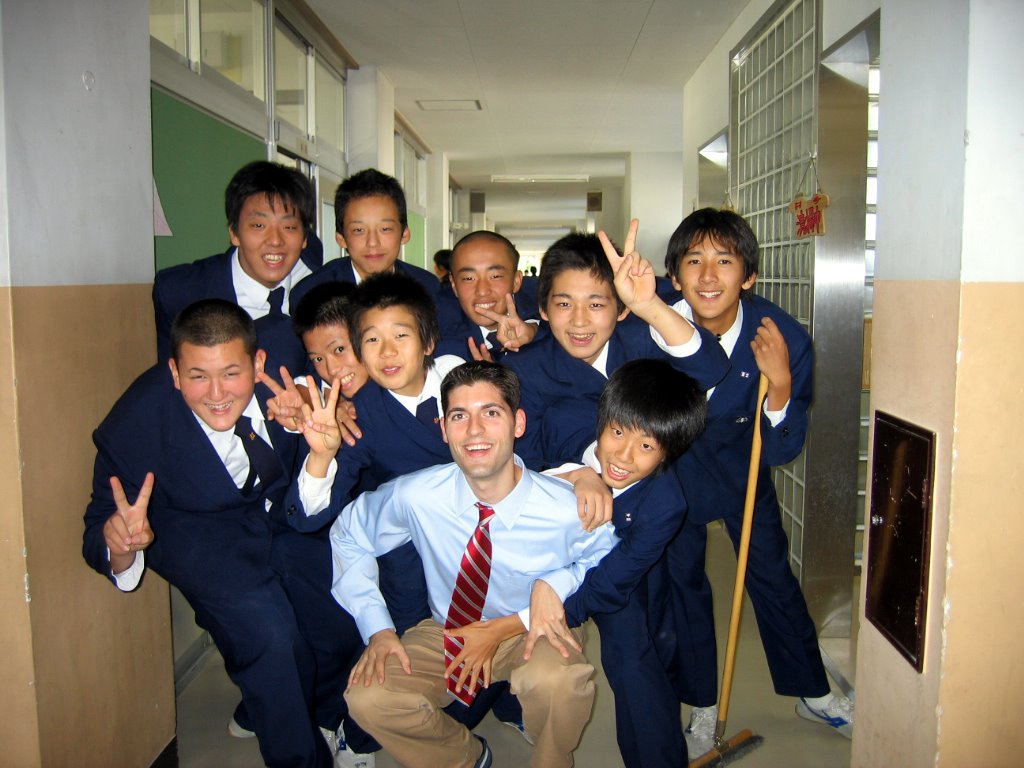 It seems like a long time since I first stepped into a classroom. A year has come and gone, and in its course yielded unanticipated lessons. I’ve chronicled the day-to-day mischief and chaos I’ve witnessed, but after the final bell, what has this teacher learned?
In a world of poverty and politics, natural disasters and nuclear weapons, I’ve come to value innocent students as an outlet for juvenile jokes and mutual companionship. School immersed me in the simplicity of malleable minds free of adult worries and real-world problems. 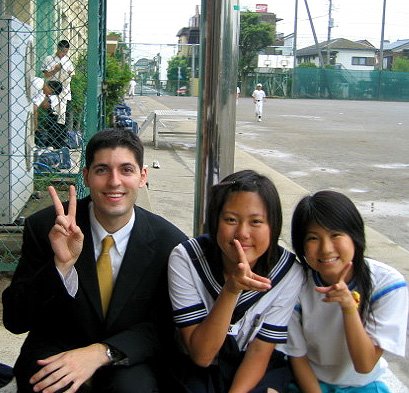 Junior high in Japan was a triumphant return to a time in America that I’ve tried to black out; I never even bought a yearbook then. This job gave me an opportunity to make up for one of those three years of misery. More than 10 years later and on another continent, I finally became one of the cool kids, just disguised as a teacher in Pumas.
Friendship was superficial, but I wasn’t expecting to forge life-long connections with kids half my age. We bonded for the moment, and it was the moment that counted. Our lives intersected fleetingly, but these students touched me (spiritually, but certainly also physically) in ways their American peers could not.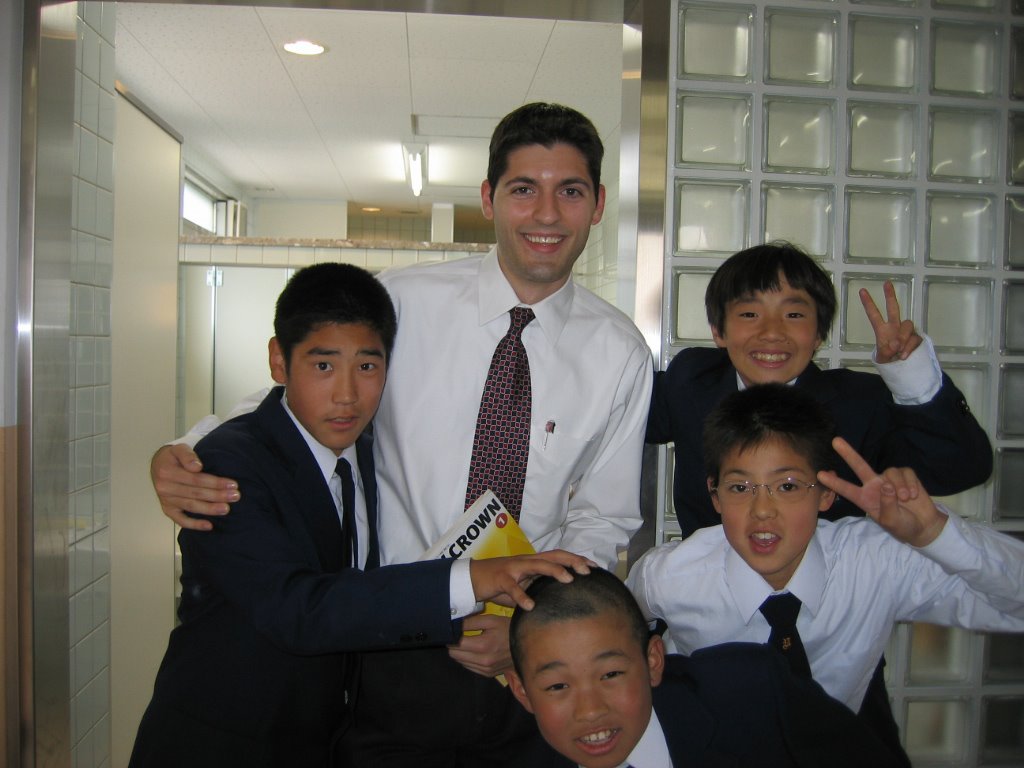 They patched a void of camaraderie in a confusing culture where I maintain shallow roots. Japan – with its traditions, etiquette, food, and language – is arguably the most complex country on earth. To even begin to grasp the intricacy of this society is a challenge that takes months of close observation. Businessmen and tourists don’t stay long enough to gain a sense of true Japan.
I came face-to-face with raw culture in a working class ward not in any guidebook: I participated in daily life at public school. In return, students got up close (and often too personal) with a foreigner otherwise inaccessible at their sheltered age. We symbiotically brightened the boredom of the curriculum through high-fives, immature jokes, and recess sports. The universality of shared company overcame the awkward exchange of languages. When crossing cultures, baby steps in communication feel like a big connection. With wide eyes and curling corners of mouths, they signaled that our company was more than just shared – it was appreciated. Even cherished. I felt like big brother, and wanted to hang out with students after school and pass around bags of dried squid and melon flavored chips while fighting over PlayStation2 controllers.
After growing up, I never thought much about kids, especially not working with them. I became a teacher in Japan because it’s the easiest path to a work permit. I never expected to become attached to those half my age and of a startlingly different ethnicity. They taught me more about life and about myself than I taught them grammar. We grew together, but on different wavelengths.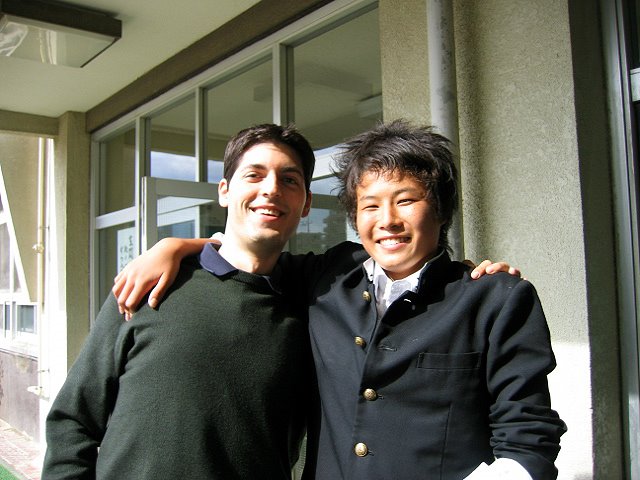 Through teaching I came to understand the power of a personal touch. Few jobs can influence the direction of someone else’s life. Part educator and part entertainer, I planted seeds of English and Americana in spongy minds. I know that more than a few will mature into interpreters, translators, even English teachers. I never realized this power from my days on the receiving side of the lectern.
A Douyoto School girl chose this to say in a composition about “one important thing:”
Though I’m doing bad and good things…varied things, I’m having a good time at school. I think I can enjoy school life by grace of friends. There are disgusting things in my school life. But my friend gives me spirits a lift when I feel down.
The school which has many friends is pleasant place!! I have a dream. One day, all students will go to school.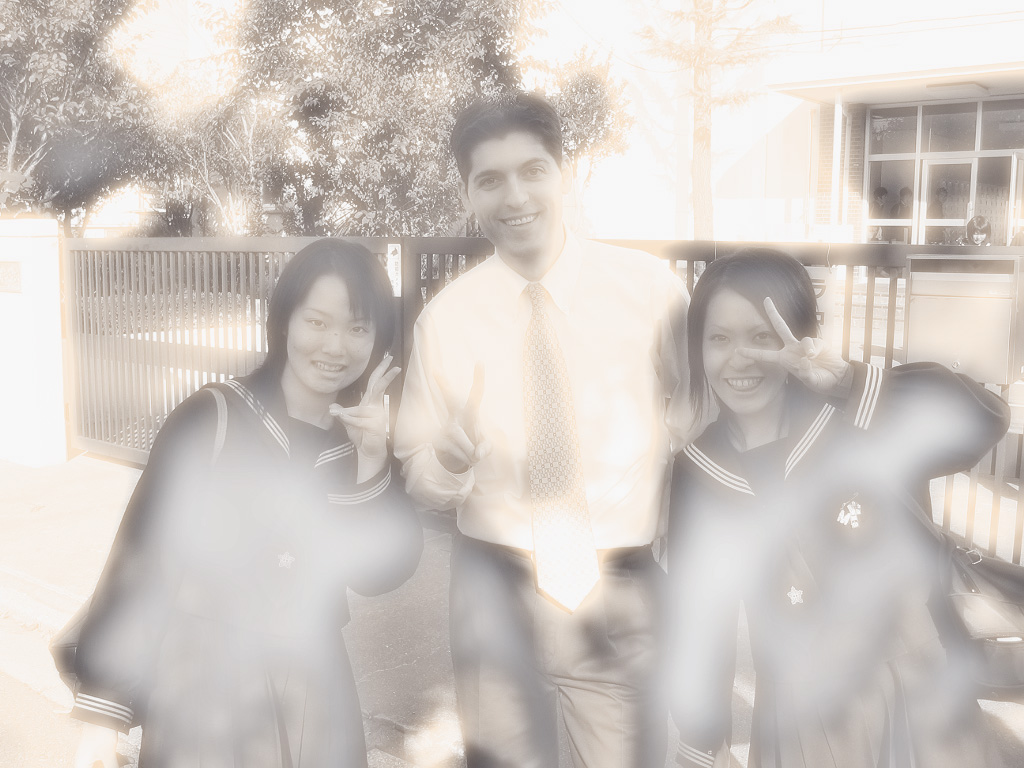 To be a part of these young lives for however brief, the memory – on both sides – will persist. None of them (thank god) are reading this, but if they could, I’d want to look them in the eye and with a slight bow of my head say “thank you.” You were my reason for staying in Japan – hundreds of reasons, in fact. Each one similar but slightly individual.
The end is just the beginning. Stay tuned for a whole new season of students.
The New Batch drama premiers this September.
Thursday, June 29, 2006
Last Day
Kanokita School is laid out in a horseshoe. Characterless five-story buildings surround a central courtyard with a gated entrance. Every morning, teachers, PTA members, and the principle greet students at the gate as per Japanese custom. They also serve as a checkpoint to inspect hair length, uniform collars and buttons, and to deaccessorize jewelry. Makeup is also forbidden.
Bowing on the run, I utter a hurried “ohayo gozaimasu” to the greeters two minutes before the bell chimes. The courtyard leads to the main building where faces suddenly appear in half-open windows. Hands poke out like little prisoners in the county jail. “Ooh Jeffurey!” they crow while waving to me and smirking to their friends – probably about my commuter tennis shoes or funky tie. This ritual occurred each morning on the way in and afternoon on the way out.
Walking out on my last day surely would be memorable. A scream rang out from the fourth floor window. I recognized a boy with no English skills hanging his mini-mohawk outside.
“Fuck you!” he shouted.
His words rained down on me like bricks. My heart pounded. Pride bubbled inside. What excellent intonation and diction! His English had definitely improved. I congratulated him with a salute of the middle finger, and laughed all the way to the bus stop shedding a tear of joy.
Well, at least that’s how I envisioned my grand exit from one of Tokyo’s most dysfunctional public schools. At Kanokita, however, such insolence only qualified for a regular day. This one was a Wednesday in September.
In reality, while counting down the final hours, Ms. Hattori dropped a stack of papers on my desk. I gave her the look. I didn’t do grades, and it was a little late for lesson planning. I looked down again. Suspicion melted into surprise. 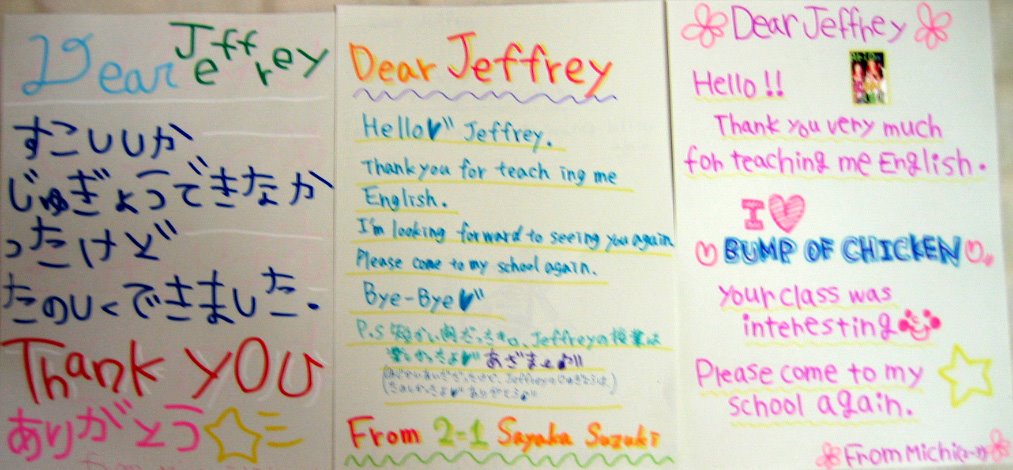 This was the lesson plan! Students had spent a period decorating goodbye letters in rainbow ink. My heart tingled like when someone unexpectedly remembers your birthday. The stack was too thick to review on the spot, so I peeked at a few and savored the rest on the commute home.
I hunted down several students to pass out the remaining pictures I had snapped of them over the course of the year (as a cover for my ulterior motive of posting them online). I couldn’t recognize some because heads sprouting bushy hair in the photo stood before me cleanly shaven and vice versa.  It was now after 5:00. I had never stayed at school this late. A lone flute trilled somewhere down the hall. Dribbling echoed in the gym. The tranquility of after school clubs reigned in the absence of daytime mischief-makers. I joined the basketball team for a few lay-ups and blocked shots. Students gathered to give me a last round of high-fives.
“What’s my name? What’s my name?” a boy in a black Nike t-shirt asked with Destiny’s Child-like insistence. I could only pat him on the head. Kohei was quick to remind me.
“Good luck, Kohei,” I said as our brown eyes connected. “And practice your English, okay, buddy?” Our palms smacked together one last time.
Pushing through the creaking metal gate, I walked out of the courtyard and toward the bus. I reached into my bag for headphones. Just as I was about to juice up my iPod, I thought I heard the wind whisper my name. I turned around. It was Kohei.
“Jeff-uh-ree, Jeff-uh-ree byee-bye!”
The final farewell. For the third time. It was just like the ending of a romantic movie – except that we weren’t in love. We were partners. Partners in a cross-cultural exchange whereby they heard a native English accent without a CD player, and I vicariously experienced Japanese adolescence (going through puberty once firsthand was more than enough).
Kohei, shivering in basketball shorts under darkening March clouds, suddenly represented the hundreds of students I had stood before with an open textbook. The dozens who made me laugh with their “Japanglish” or universal acts and words of immaturity. And the handful who touched my heart with their gentle personalities and genuine interest in English or America.
Beyond textbook scripts and the supervision of other teachers, exchanging a spontaneous sentence or two with these special youngsters made the day’s commute worthwhile. It made the move to Japan worth the effort. Kohei was the last one of them that I’d ever see, ever interact with. He stood there smiling and waving like a happy dog.
I waved back and walked backwards. I couldn’t see the Swoosh on his shirt anymore. My eyes were misty. The setting sun and approaching cold front cast an eerie orange glow. Heaven’s tears showered the bus just as I boarded.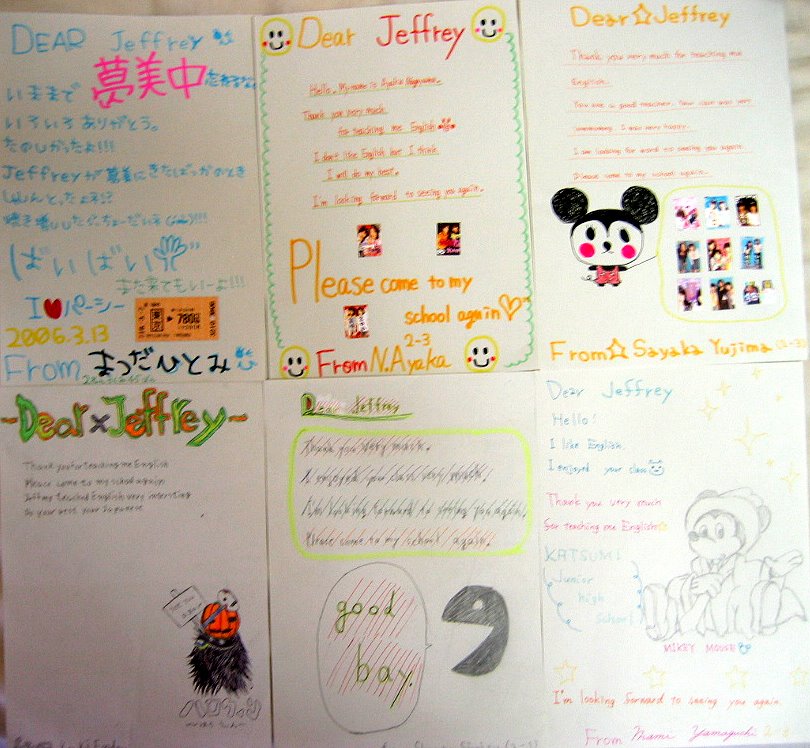
Friday, June 23, 2006
Nuts for Nuts
“Hello, how are you?” plays like a broken record from my lips during school hours. The next most uttered phrase is “Don’t touch me!” Unfortunately, it’s yielding diminishing returns.
Students now mimic me as they swarm in to cop a feel. What would be viewed as perverted or queer in America seems perfectly playful among touchy-feely Japanese school boys. The progression of the school year has only fueled their aggression for my receiving unwanted attention.
The final days of my tenure as a public school assistant language teacher bore an unprecedented number of bold attacks on private parts in public places. After lunch with one of my favorite classes, the boys were feeling frisky. There had been grabbing before, but not like this. Had there been something extra saucy in the fish cake lunch?
I enjoy mingling with students in the unstructured 20 minutes that follow lunch, but as a spectator manage to stay above the fray of pile-ons, insect-catching and games of onigokko (cops & robbers). Not today.
Larger classmates were preying upon “little angel” (my nickname), the smallest and most adorable boy of the class. He was in the fetal position on the floor protecting his vital organs and sacrificing his shoes in the process. I stepped in to repossess his footwear, but was suddenly swept up in what could only be described as a round robin kancho free-for-all.
“Clitoris!” the naughtiest of the mob shouted, catching me off-guard and scoring a direct hit (grab) on my crotch. I cursed him off in English, and side-stepped a second strike. The halls echoed with the frenzy of high-pitched screams and squeaking sneakers as the boys turned on one another.
“This is new sport,” one boy said rushing by with an outstretched hand in pursuit of his friend. I cautiously slid to the nearest stairwell. If kancho were an Olympic sport, I’d award Japan the gold.
* * *
English words were the last thing the boys in the back were penciling into their notebooks. One sketched a picture of a boxer with oversized gloves and long, wavy hair. When I walked over, he labeled it Jeff. He then asked for vital stats to accompany the diagram.
“I’m 185.3 cm. Taiju is 70 kg...what did you say? You little pervert!” I slapped him on the head. Here we go again, I thought, but this time was different. His friends coordinated a two-prong attack. One lunged for the front while the artist reached for the rear.
They took stabs at the American flag erasers I was holding. One snatched it out of my hand and wouldn’t return it, only offering to arm wrestle for it. Intimidated by his spiky hair and shaved eyebrows, I let him keep it.
I looked up to the front of the room to call for backup, only to find that the Japanese English teacher had already left. I looked back down. The artist pulled out a ruler, pressed it against my upper thigh and scribbled a measurement in his notebook.
* * *
I always walk around on high alert when in the presence of Kanokita 7th graders. Although the nickname applies to many, one kid tries so frequently that I’ve dubbed him “The Crotch-Grabber.” This picture caught him in the act. (The green and white sleeve is outstretched to ward off the attack).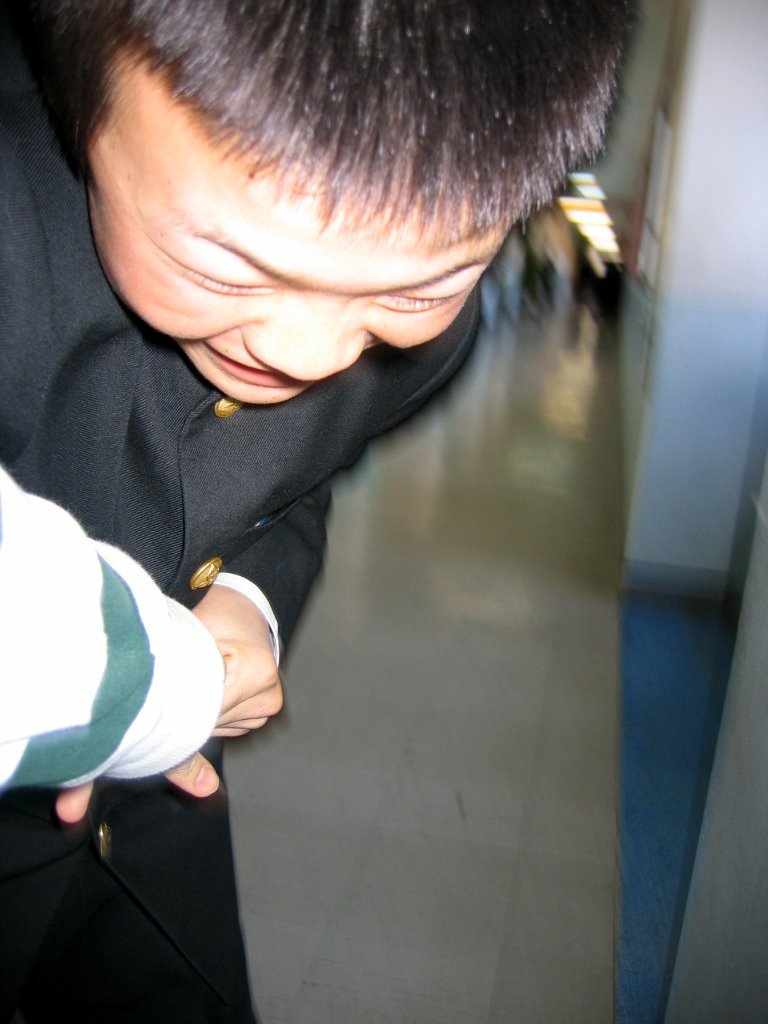 Today’s class was handing back midterms full of red ink. The student who scored a 96 was sculpting dried flakes of white out into lines on his desk. Kenta scored a 4. He already drew my sympathy as the class shrimp, always looking lost behind long hair that curled on his neck like the crustacean’s tail.
“Thirty-five?” Crotch-Grabber whined as he crumpled the paper. Devoting more attention to vocab lists instead of my groin would surely increase his rank.
After class, Crotch-Grabber found me in the hall. One wrist was bandaged, which I thought would slow him down. It only increased his ingenuity. He faked his hand down and pinched my nipple. I yelled. The crafty kid offered me a high-five apology, but instead gave me a low grab.
A passing teacher laughed it off as cute, but I didn’t think it was so funny. I wrapped my hands around his neck and pushed him into a corner. Then the tables turned. It happened fast. His friend swooped in for a hit, allowing Crotch-Grabber to break free and renew the assault. I blocked, but our arms tangled. My ankle turned. I didn’t know how to tell him it was still in bad shape after a basketball injury a few weeks before.
To take the pressure off, I leaned on my other ankle, but balance befell me and I took Crotch-Grabber down with me.
“It hurts!” he yelped in Japanese while clutching his bandaged arm that I had just landed on. Nervous and apologetic, I put my hand on his shoulder. Grinning, he slugged his free fist into my crotch.
Friday, June 02, 2006
Money Hungry
“Money and Card” was the title of the final lesson with Mr. Mochizuki. Preparation was simple: wow the kids with faces of dead presidents on American currency. I brought a dollar’s worth of new pennies to Japan to inspire interest in American culture, and as backup should pencil prizes become exhausted.
The first student to guess the value of the coin I held up received a cash prize. Like ravens, shiny coins distracted 7th graders. I wasn’t so generous with the bills. I weighted down $1, $5, color $10, and $20 notes on the front desk with piles of pennies, and called up rows of students for a viewing. Their eyes turned green, and begging began.
Upon realizing that I was lax about their taking centy souvenirs, they got greedy. They clamored for something I walk away from when dropped. There were a lot of outstretched palms to grease. One kid reacted after smelling a fistful of change. Yup, smells like America all right. Japanese currency is somehow odorless.
I brandished a credit card to regain the educational focus of the lesson. This only stirred the pot. Visa is not everywhere you want to be in this cash-based society, and I transformed from assistant teacher to Daddy Warbucks. The bell rang before I could count my change, but by then it was too late. About 25% of the kids made off with 75% of the coins.
I stuffed the bills, card, and a few remaining dimes into pockets while shaking off demands for more. I continued to laugh until they started poking in places I didn’t wanted to be touched. One pilfered the bag of coins from my rear pocket. I beat him on the head with the textbook until I got a refund.
I consolidated valuables into the front pocket and made for the door. Three kids blocked my path. I sliced through them, but two more held the door shut. I needed backup, preferably an armored car, but even the bumbling Mr. Mochizuki would do. He had already left, and I had to fend off the mob alone.
Driven by hormones and greed, they groped and grabbed – my pockets, buttocks, anything they could get their dirty little fingers into. Outnumbered and outmaneuvered, my bum ankle only hampered my agility.
They were swarming now. Desperation swelled in my gut. I went into survival mode, and backed into a corner. One tried to sneak behind me, so I used my hips to check him into a metal cabinet. He yelped, holding his hand in pain. Others reached in for the “arm”ed robbery.
I knocked two boys out of the way, and broke for the back door again. The kids exited from the front, and confronted me in the hallway. Once there they suddenly became like fish out of water. Although their momentum died, it wouldn’t be the last time they tried to make off with my jewels.
Stay tuned for “Nuts for Nuts”….
Monday, May 29, 2006
Vocabulary Building
As class began, SexPlayer approached me with a new word on his mind. “Service parlor,” he blurted out. I’m not sure exactly what he meant, but my best guess wasn’t too savory.
For students without inklings for English, it’s tough to find something both educational (even marginally so) and that keeps their attention (and mine). Thank goodness for the word association game. It’s my go-to activity whenever I have ten minutes to kill, or have lost patience trying to teach the textbook. Please allow me to introduce it to you.
Hello, class. Do you know the word association game? Okay then, watch me, please. S-c-h-o-o-l [I write it on the board]. School means gakko desu ne? Okay, now what is in a school? Students, teacher, class…or…desk! Okay, d-e-s-k. What is desk? Chair or…wood! Okay, w-o-o-d! Wood is…brown, tree…. Do you understand? Okay, okay, let’s play now.
The rules are simple, and the results interesting. Here are some teacher-vetoed associations students (read: boys) came up with:
- speak…mouth…
smoke - needle…
HIV - pie…meat pie…cherry pie…
cherry boy - toy...
adult toys - wedding…baby…
six nine [69]…mother…Meg Ryan…children…Mr. Children…Michael Jackson
Shrimp…lobster…crab prompted Me Too Pants Dropper to make lewd clawing gestures while pointing to girls. Another boy tried to make an association from that by crying, “Let’s play masturbation!” Me Too Pants Dropper pointed and fired back, “Masturbation boy!” I desperately tried to divert their one-track minds to words I could write on the board. Like “winter.” But Me Too Pants Dropper heard “wiener,” and yelled out “meatball.”
A tamer class started the game with “school” and followed it with “teacher…student….” The final two words before the bell rang were “danger…landmine.” By the law of syllogism, school is a landmine. At Kanokita, teachers already know to tread with caution.
Monday, May 22, 2006
Naughty by Nature
Behavior of perverted, pubescent students at Kanokita has been well documented.
Although I get tired from standing all day, one perk of being a teacher is the freedom of classroom mobility. I call it “The Teacher’s Walk,” and mine sort of looks like a giraffe drinking water. With hands clasped behind my back I methodically pace and pause up and down rows, lowering my neck to inspect desktops.
I walk mostly to keep from falling asleep, but also to joke around with students and to encourage them to at least put books on their desks. This time, Glue Boy in the back corner had another idea. From inside his desk emerged a tissue-covered cup. I braced myself. He yanked off the tissue. A penis sat in a glass of water. It was one of those Grow-A-Penis things that swell when immersed.
I tried to act like the mature professional that I am, and said: “Chisaii chimpo!” He burst out laughing; it was indeed a small pecker. 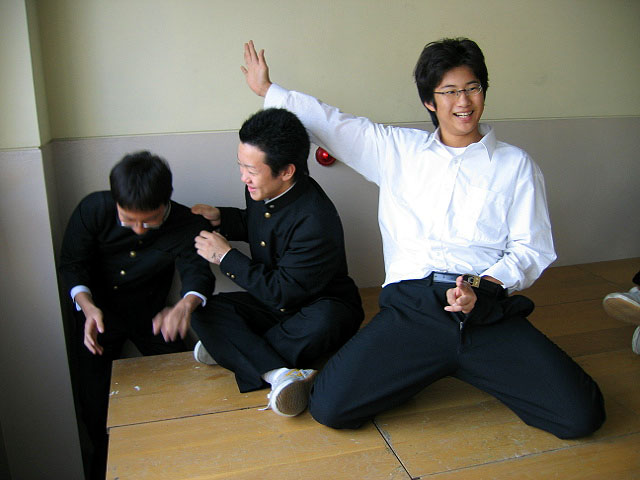 Later on I was Walking to check the lack of progress in copying sentences from the board. I couldn’t help but ask Glue Boy, “Hey, show me your penis.” We both laughed, and he ducked his hand into his desk to whip it out.
* * *
Eating lunch with students is my favorite time of day. First of all, I’m fed for cheap. Second, anything can happen. And it usually does when taking meals in section 2-4, home of Potato Face, Me Too Pants Dropper, and SexPlayer.
It was a Friday, and these boys were in weekend mode. I opened the door to a scene of culinary chaos. Me Too Pants Dropper was inhaling globs of rice with baby sardines by the fistful while banging his spoon on the lunch cart to demand more from the intimidated girl server. His shirt was untucked and unbuttoned. From the lunch cart he also grabbed the last frankfurter with his teeth and taunted SexPlayer with it. The ever playful SexPlayer bit the other end and tugged.
I ate alone, but as I was finishing the boys closed in. I guessed what perverted question would spill from SexPlayer’s mouth. Usually he lives up to his nickname by asking me if I like to play sex or if I like to play sex everyday.
“Do you like adult video?” he chirped. I almost congratulated him for asking a new question, but replied negatively hoping to end the line of questioning. It didn’t. SexPlayer brought over his book bag for some show-and-tell.
“Porno DVD!” Me Too Pants Dropper exxxclaimed, announcing the obvious. I was floored that they had gotten their hands on another objectionable item (at least this one didn’t shoot pellets), and had brought it to school. They circled me with eyes and ears eagerly awaiting a response. I couldn’t disappoint. “Mimashou!” (Let’s watch!) I shouted to a chorus of cheers.
At other schools class can be as quiet as a library. At Kanokita, however, the only way to get students’ attention would be to press play. Something tells me it wouldn’t be the first time they’ve seen it.
SexPlayer started sucking on Me Too Pants Dropper’s index finger. I rose to rack my tray. SexPlayer followed, and I asked him what other videos he watches. “I have two at my house,” he said. “Toy Story and adult video.” 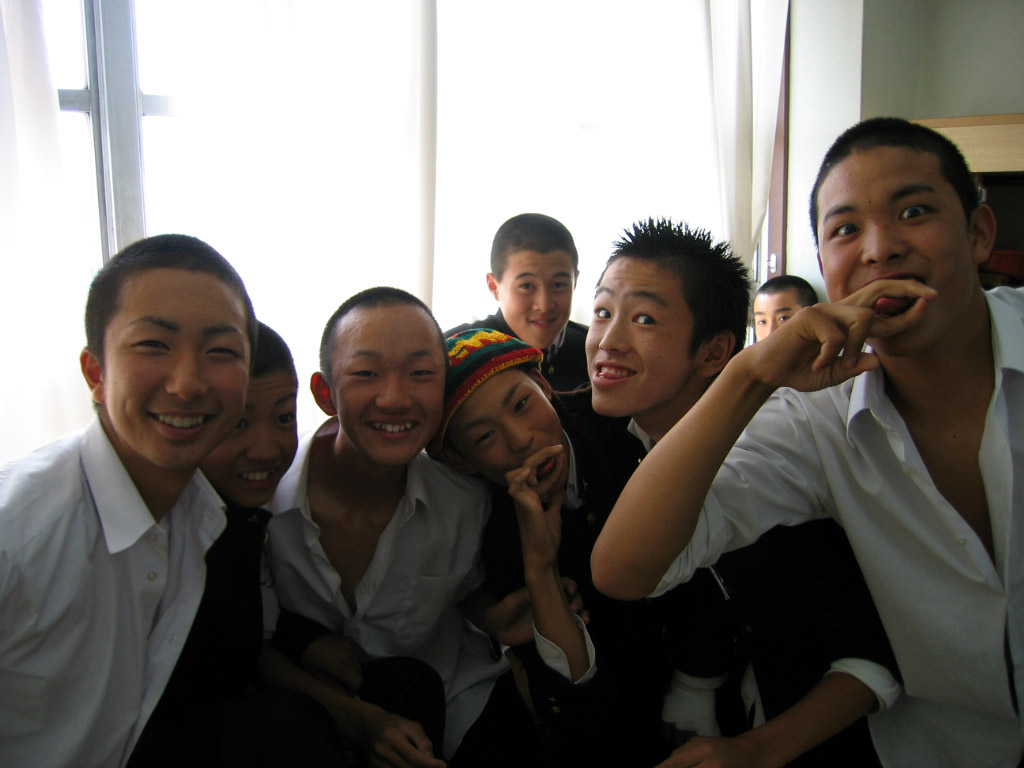 Far left: Potato Face. Center with Rasta wig: SexPlayer. Far right: Me Too Pants Dropper.
* * *
Hormones run high at Kanokita, but those inside Me Too Pants Dropper are off the charts. He’s grown by inches in months. Now I look up at him, which he never lets me forget by sliding up next to me before class with big brown eyes and a naughty smile.
“Kiss me, please,” he likes to ask before class, pointing to each cheek. I send him back to his seat unfulfilled.
“Would you come here, please?” he asked during the lesson. I should know better than to accept his entreaties, but sat down next to him to see if he’s added anything new to his routine. “I like sex play. Do you like sex play?” Same shtick. I turned away, but he patted me on the shoulder. He smiled devilishly, and began stroking my knee, moving his hands onto my thigh.
“Enough!” I yelled, jumping up and causing a disruption.
“Wait, please!” he begged, sticking out his tongue and winking.
One time he tried a more direct approach: “please tell me about your penis.” His pronunciation hasn’t caught up with his hormones.
“My parents? Oh, well I have one mother and one....”
Slowly, I’m teaching them. We’re starting with the small stuff. Don’t raise your middle finger. “F*%# you” is not pleasant parlance. Erase “COCK” from the blackboard and your textbook cover. And please don’t describe your weenie as an “anaconda.” You’re 14 years old, and Japanese at that.
Wednesday, May 17, 2006
Crime and Punishment
Just as class finally settled down, Seiko strolled up to the front. She was holding her head. Mr. Hirogashi wrote her a pass, no questions asked. He’s just as happy to get rid of her as she is to get rid of him. Her hand was glued to her forehead, but only figuratively. It’s not a migraine, but rather a bad hair day. She’s been having a lot of those ever since her father lopped off her prized bangs as punishment for misusing a vending machine.
He should have trimmed her tongue instead. While waiting for the pass, Seiko couldn’t help but be a nuisance. She looked up from the floor to crack jokes at my expense. They’ve become so repetitive that I can now understand almost everything she throws my way. I counter with squinted eyes.
Discipline is deteriorating at Kanokita like the paint flaking off the walls. Some behavior qualifies as bad even for public schools in America. Fourteen-year-old girls, Seiko included, were caught red-faced after drinking beer (from a vending machine) in the bathroom in between classes. Not that they attend those classes, but the school nurse solved the mystery of their suddenly flush complexions.
Several boys, meanwhile, uploaded pictures of lighting up on school grounds onto their homepages. Word spread quickly. Enforcement of rules has not. The usual morning staff meeting at other schools is held in the late afternoon at Kanokita, probably to take stock of the day’s carnage and to make sure all teachers are accounted for.
In between classes one day, I returned to the teacher’s room to get more pencil prizes. I didn’t understand an announcement on the PA system, and empty chairs greeted me the next period. Class was cancelled. An emergency assembly was held instead because papers spontaneously combusted in the bathroom for the second time in four days. The fire department knows the route here well. Alarm pulling, or paper burning, has proved effective in postponing class.
Walking out of school one afternoon, I approached a girl shivering in the cold. Her skirt bopped up and down as she sang along to the J-pop playing on her cell phone speaker. She congregated with a group of boys on the steps near the gated entrance.
Their eyes radiated mischief. This group also hangs out on the fire stairs in front of the building. A boy sporting a mini-mohawk smiled suspiciously. As I walked by, he opened his uniform jacket and pulled out a gun. His grin exploded into laughter as he fired blanks at a student peeking out from behind the gate.
The kyoki (murder weapon) fooled me at first. But this is Kanokita where anything is to be expected, and so long as the gun’s not real, it’s not threatening enough to take meaningful administrative action. Try telling that to the special ed students caught in the crosshairs and rushing through the gate to reach the safety of waiting vehicles.
Seeing a policeman with the principal in the corridor doesn’t raise eyebrows. Last year the school made national news when a dozen girls were arrested for fighting. The melee unfolded on an embankment where they were trying to throw (drown?) someone in the river. The only thing that sunk was the school’s reputation.
The headlines never seem to fade for nearby residents. Sometimes I meet people who grew up or now live in the ward. While not an alumna, Carrie at Hollywood Models was well aware of Kanokita’s reputation. She cited breaking windows and casting a teacher’s chair into the pool as less criminal mischief.
What it boils down to is that these kids are just naughty by nature…To be continued.
Sunday, May 14, 2006
Vanity
The beauty parlor was in full swing. Mirror, brushes, pads, lipstick – cosmetics crowded the desktop. A dumb-looking girl adjusted her fake eyelashes. She applied blush and eyeliner with the vigor of an actress due on stage. All that was missing were the vanity lights, but the oversized mirror was enough to draw the teacher’s disapproval.
She continued primping despite being instructed otherwise. When the teacher walked over, the girl glanced up with a vacant stare, her fingers still on her lashes. I recognized the stare from when I had asked her what she did on vacation. Maybe she didn’t understand a word of English. Maybe it’s Maybelline.
The Japanese take beauty seriously. While it’s taboo to eat or drink on trains, women routinely apply makeup as if they were in the privacy a dressing room. Men trim and reshape their eyebrows (not on board). Some shave them off completely. The grooming begins in junior high school, and is especially noticeable at Kanokita where students prioritize plucking over cracking a book.
Popular in-class treatments include gelling each other’s hair, filing nails and straightening hair – one strand at a time. Even the boys tote oversized mirrors that they prop open on the desk and spend the period perfectly aligning their spiky hair. The mirror reflects their attention away from the board. Such was the case with one punk with a band-aid patched over his eye and a (fake?) Burberry scarf concealing his neck. When done attending to the hair on his head, he shifted gears to tweezing his eyebrows.
In another class, two kids plucked the body hair off of an early bloomer. One friend dutifully worked on the boy’s arms while his exposed leg rested in the other’s lap. He didn’t flinch much, perhaps numbed from the sound of English.
Personal care isn’t all glamour. Sometimes it’s messy. Like when one student got a trim. Or when the normally well-mannered “Harajuku boy” (as I call him ever since spotting him on the train bound for this trendy area of Tokyo) was playing with shards of glass from the mirror he had sent crashing to the floor.
Perhaps following his lead, a girl with a black kit on her desk threw tweezers, eyebrow clipper and eyelash crimpier to the ground in apparent frustration. The girl sitting behind her remained cool, and continued straightening her frustrated friend’s hair with a turquoise comb.
This teacher is sensitive to some classroom salon treatments. Seiko and Maki bring tears to my eyes when using hair spray on each like they’re in a shaving cream fight.
“This room smells funny,” I remarked to the Japanese English teacher after walking into another class. He sniffed and agreed. This time it’s not hair spray; it’s nail polish. I scanned the room for the culprit. A girl with a pink hair clip was painting her nails at the expense of my nostrils.
To avoid confrontation, the teacher asked her not to stop, but to instead do it later. She pleaded for one minute more, and of course ignored the clock and his empty threat. Class began, and so did rawness eating at my throat. Disrespect had crossed the line into physical discomfort.
I mulled an appropriate response. I, too, didn’t want to cause a stink, and realized that if you can’t beat ’em, join ’em. She didn’t look up when I towered over her desk. I silently stuck out my pinky and received a glittery coating. The Japanese teacher followed suit.
Meanwhile, a misguided boy was working on his own version of nail care. He super glued his thumb and index fingertips together, and raised his hand for me to hail his accomplishment. I gestured back. As long as he wasn’t eating it, everything was relatively OK.
Thursday, May 04, 2006
I is for Impunity
Near the bottom of Tokyo’s public educational barrel, Kanokita School appropriately sits in the shadow of the regional garbage incinerator. Toxins must seep into the water table, too.
I share a bus ride from the nearest train station with a disturbing number of mentally disabled adults. They are the only ones naive enough to sit next to a foreigner, although my knees do jut into the adjacent seat, sometimes the last one available.
An otherwise routine trip was once enlivened when one such man boarded with a bottle of brown “English tea.” Drinking on public transportation is frowned upon, but that didn’t dissuade him. He was audibly slobbering on the bottle. How refreshing to have the other passengers furtively eye someone else for a change.
While the bus was in motion, he leaped up and lunged across the aisle to slide open the window, dripping tea on an elderly passenger. He ejected the bottle from the window. Plastic rattled onto the pavement. The engine drowned out stifled reactions.
However small, it was a rare breakdown in order here. Well, rare if you’re a stranger to Kanokita. If D is for Delinquency, then I is for Impunity.
A pack of wild girls runs down the hall feeding off disorder it incites. Like a car with squealing brakes, Seiko’s shrieks can he heard down the block. First, she’s in the hall. Next, the fire escape. Then she’s yelling upstairs to Maki from the flowerbed in the courtyard, her uniform snared by branches. An old custodian lady pleads her not to trample the greenery.
A teacher told me that the outdoor pool is the only one in the ward to freeze in winter because it faces west and receives no direct sunlight. This distinction would qualify for an achievement at Kanokita were it not for the students who nearly fell in after treading on thin ice. Others kept their distance from the safety of fourth floor windows and pelted the ice with Mandarin oranges from school lunches, now a free meal for the crows.
Sometimes their boldness is welcome. Students freely adjust the classroom thermostat, which often works to this sweaty American’s favor. I silently cheer when a student pumps up the a/c. During spring rainy season either I’m getting soaked from above or sweating from underneath.
A tradition dating back to temple schools from the Edo period, students are assigned daily after school cleaning tasks. A rotating wheel of chores keeps track of who is sweeping where that day. Kids arm themselves with hand brooms and washcloths as chirping music sounds over the PA system. The tune mimics what’s heard at a closing department store. Chairs are raised, desks pushed to the side, and dust balls and spilled rice grains swept up. Others rub washcloths along the banister or wipe the linoleum stairs. At Kanokita, however, there’s no music – only the huffing of teachers carrying cleaning supplies.
The only thing that students who don’t want to learn have learned is that they don’t have to learn if they don’t want to. When students wield more power than teachers, threats are hollow and discipline is unenforceable.
Such antics wouldn’t go unpunished in U.S. schools. There are principals to lay down the law and detention for those who flaunt it. In Japan, principals are powerless and detention is a foreign concept. It’s the fundamental right of students to attend class. Kicking kids out would be to deny them this right. Students hold the ace of spades. Except for when after class began I broke up a poker game on the grounds that if I wasn’t dealt in, then nobody was playing.
While sometimes I use outsider status as leverage to encourage good behavior, specialized Japanese “cowboys,” as I called them, are the only hope of containing problems. In the absence of respected authority, cowboys patrol classrooms and hallways to prevent rebellious teens from taking over the ranch.
Chief cowboy Koutoro is a cool 30-something friend to the students and ally to the out-of-touch staff. His hairstyle matches his eclectic taste in fashion. The kids liken his stringy bangs plastered to his forehead to pubic hair. They have a point. He began as a volunteer five years ago, and now is the longest tenured member of staff.
The student-teacher ratio in one class was 3:1. Two English teachers, two cowboys, and one other man were on hand to lead and observe class. The problem was trouble itself. These 8th graders were perfectly behaved.
Although not (yet) as treacherous as their sempai (elders), the youngest students influence classroom life. I suggested dividing into groups to play a game that worked well with elementary schoolers I once subbed for. A 7th grade class at Kanokita has about the same English ability. The Japanese English teacher rebuffed the idea: “This class doesn’t do groups. If we try, one or two groups won’t participate.”
We’re teachers. Time to show ’em who’s boss, right? To the contrary, the mischief only gets worse….
Thursday, April 13, 2006
Changing Tactics
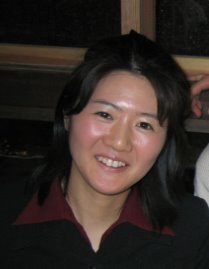 Lately, Ms. Hattori has gotten smarter. Battle weary from the daily onslaught of Kanokita’s 8th graders, she has sacrificed a fellow freshman teacher to the front lines. Instead of leading class from the front, she now stands in the back and watches me sink. Why should she do the heavy lifting when the burden can be shifted?
I waited for her usual shouts to begin class, but they never came. I stared at her, and she stared back. So now I’m expected to take the reins, which were slipping by the second as students picked up on the breakdown in command.
I made the class repeat the greeting because instead of responding, “I’m fine thank you, and you?” they echoed the question, “How are you?” Today’s lesson plan featured an unseasonable dialogue about Thanksgiving Day. I repeated the model reading, but no matter what the month, these students aren’t listening.
From the back Ms. Hattori cried, “One more time,” which became seven more times. A few mouths moved, but were inaudible because the gang of four was concocting trouble.
Birthmark boy is the ringleader, but he gets a little help from a girl with pale skin whose attitude turns mine red. Neither had a book open, unless you counted her journal filled with mini photo machine stickers and magazine cutouts of fashionable J-teen icons.  Before class, birthmark boy invaded her privacy and introduced me to this revealing slice of middle school girl life. Hours (of class time) are spent coloring pages with thick Poca markers and gluing in small photos. It’s an illustrated diary of friends, friends turned enemies (blackened out faces), material desires (cell phones, clothing) and their concept of beauty.
As I thumbed through the book, I got slapped on the head. Its owner had returned was none too pleased. I shifted attention to a boy with a crew cut (usually an indicator of trouble) squeezing swirls of Elmer’s glue. It looked like marshmallows had melted onto the desktop. As I approached, he glanced up to say “petting.” He wasn’t talking about his dog. He flashed a vulgar gesture and repeated himself while pointing at journal girl. Maybe it’s a good thing she can’t understand English.
“Where’s your book, kid?”
“At home,” he said, his lips curving upward. “Heavy petting!” he then exclaimed.
I kept a straight face. Now where did he learn that? In a weak moment months ago, I taught Me Too Pants-Dropper boy the same phrase after he, too, said “petting.” I’m sure it was the end of a long day, and I thought it would be harmless. I mean, these kids use “good morning” as an after lunch greeting.
I tried not wasting much time with the gang of four because several students in the front were actually making an effort; however, the gang distracted everyone. Glue boy tossed a button from his uniform and a battery at birthmark boy. Tired of mild threats to encourage attention, I marched over, confiscated the items and threw them out the third floor window.
I should have tossed out the glue. After joking in Japanese that I wanted to drink it, glue boy uncapped the bottle and began squeezing – above his open mouth. Nothing came out. He squeezed harder.
「ばか! ばか!」 I warned “stupid.” Curious to see how far he went, I didn’t intervene. Even Ms. Hattori was watching after having migrated to the board to write some sentences.
The glue oozed out like a string elongating with gravity. And then it snapped. I was hoping for down the throat, but it missed and pooled on his nose.
“Told you, stupid,” I chimed above his cries for a tissue. Shouldering teaching responsibilities here makes it tough to get a handle on class. Not even if you super glued one on.
Friday, April 07, 2006
Loosing That Loving Feeling
It was January, my first week back after New Year’s break. I had missed the childish camaraderie, and was even looking forward to defending the privacy of my parts on a daily basis. The last update on the mischievous nuts at Kanokita Junior High was in October. I’ve been taking careful notes of their behavior since then. By now I’ve finished up at my three other schools, so the focus of the blog will shift to these bundles of trouble doing what they do best – causing it.
“Mr. Mochizuki, how are things here at Kanokita this New Year?” I asked, fishing for gossip.
“Oh, same as usual. Not in particular,” he said showing off his front teeth from behind oversized glasses. That smile always gave me the willies.
Two more days back in session would be enough to erode Mr. Mochizuki’s veneer of winter recess relaxation to the point of disillusionment: “Mr. Jef, I no like this class. Why am I appointed this school?” he suddenly complained before class. “To tell you the truth, I don’t want to come to this place. There are very bad students, maybe the worst in Tokyo.” Although shocked by his candid confessions to a younger and contracted employee, he had a point.
The honeymoon period’s over. I dragged my feet up the stairs to class with Mr. Hirogashi, a young teacher who spent December break in Hawaii on his honeymoon. Regarding the three other schools I rotate among, he asked, “Do you notice a difference between this school and the others?”
I nearly laughed out loud, but realized he was in fact quite serious. He’s fixed at one school, and sounded like he was hoping to gain insight into the outside world populated with better disciplined students.
Perhaps he’s longing for the past. After all, he met his bride while teaching in another ward of Tokyo; however, Japanese school rules stipulate that a husband and wife cannot teach in the same ward, much less the same school. So he designated himself for reassignment, which after half a year at this school must mean he’s filed divorce papers just to get his old job back.
Blood-curling screams echoed into the stairwell from an undisclosed location. It could have been from upstairs or downstairs – maybe from both. Something then crashed to the floor. Usually it’s loud and metallic, but the dull thuds worry me most. Mr. Hirogashi filtered out these background noises.
Students at two of my other three schools were angels compared to Kanokita kids. I didn’t want honesty to burst his already bruised bubble. Morale in the teacher’s room was low enough.
“Well, the 7th graders aren’t so bad,” I said with a positive spin. Actually, Omiyada’s, led by the inept Mr. Nishono, acted worse. Kanokita’s 8th and 9th graders, however, were the bottom of the behavioral barrel.
“I think this school is like a jail,” he said as we climbed passed 8th grade classrooms on the third floor – ground zero for disobedience. His analogy was faulty. Although inmates are also bad apples, and as a matter of law must remain on the premises, a jail enforces order through authoritative guards. Kanokita is more like a game preserve where wild beasts roam free in a loosely patrolled area. There are some rangers, but not enough to be effective guardians.
At the top of the stairwell on the fourth floor, we turned right instead of left. “Oh no, no, no…not this class,” I grumbled to myself. There’s only one room at this end of the hall. It’s the class with the boy with the huge birthmark on his chin whose standard greeting is, “Oh Jefu! Son of a bitch!”
There were eleven students today, but they still outnumbered two teachers. Four girls in the front row were throwing pen cases (one labeled “Bump of Chicken,” a popular band) at one another or using textbooks to inflict head trauma. The boys behind them sketched their own variations of manga characters from an illustrated masterlist.
Efforts to overlay the worksheet on top of their drawings were brushed away. When Mr. Hirogashi then tried removing the drawings, a student yelled and ripped the worksheet in half. Mr. Hirogashi acquiesced.
The girls in the back of the room were hopeless. I knew from past experience that I’d be wasting my energy. One sat on the windowsill staring into space. One foot was planted on her seat while the other leg rested across her desk. At least she looked comfortable. Beside her, a friend craned her neck out the window to report on the boys P.E. soccer game.
Two girls glanced up from writing letters in multi-colored ink. They welcomed talking to me (in Japanese), but one preferred listening. At first I thought she had a new earring, but then spotted an earphone concealed beneath her long black hair. My face lit up, and she begged me to keep quiet. I just smiled and returned to the front of the room to survey the scene from a macro level. Finely fashioned paper airplanes crisscross flight paths in the back of the room.
Except for pretending to arrange to go to a Beyonce concert with a boy who practiced English five hours a day over winter vacation, classes were an exercise in futility. The students don’t care. There’s nothing stopping them from showing it. And there’s nothing I can do except witness the chaos unfold.
Wednesday, December 21, 2005
A Very Jewish Christmas
At Kanokita, where the kids have no appetite for learning, Mr. Mochizuki passed the buck to me to answer more interviewing-the-foreigner questions to eat up class time. “How to celebrate Christmas in your home country” was first on a handwritten ditto entitled: “Let’s Enjoy!!! Mr. Jef retraces himself.”
Mr. Jef introduced the subject with skilled drawings in colored chalk. Students recognized the ornamented Christmas tree and gift-wrapped presents beneath it. So far, so good. But confusion ensued when they identified sleigh-riding Santa as a snowman. To clarify, I sketched a chimney and fireplace, and added directional arrows showing Santa’s path from the sleigh down the chimney to deliver presents under the tree. But further explanation was needed. The fireplace mantle was not adorned with a plate of rice crackers or pizza. The glass was not filled with coffee, juice, champagne, shochu or sake.
One dark Tuesday, I regurgitated this 50-minute lesson four times in a row. My holiday spirit soured by the fourth class. I lit the fireplace logs and redrew a cross-section of the chimney with a bulge and dangling legs. Poor Santa. While Mr. Mochizuki translated, I fanned the flames, which shot up and singed Saint Nick and ignited the “Christmas socks” hanging from the mantle. Soon, tree tinsel was ablaze. Some boys were giggling. I wasn’t taking any prisoners this holiday season.
I drew a reindeer. The girls whimpered upon learning that I had eaten one (yes, a kebab in Finland). Shock turned to horror as I drove home the point by sketching Rudolph’s forehead with a bite removed. I sliced open the body to add entrails spilling out in hastily rendered chalk. The bell shook me from my trance. The boys were still giggling. The girls hung their heads. I hung mine. What had I turned into?
That the day has religious roots was news to some. A few were surprised to learn that it marks Christ’s birthday, not Santa’s. One asked, "how old?" While Christmas is secularly celebrated in Japan, I sensed an opportunity to convert young minds to the joys of a new holiday. Not just one day of presents – but eight! 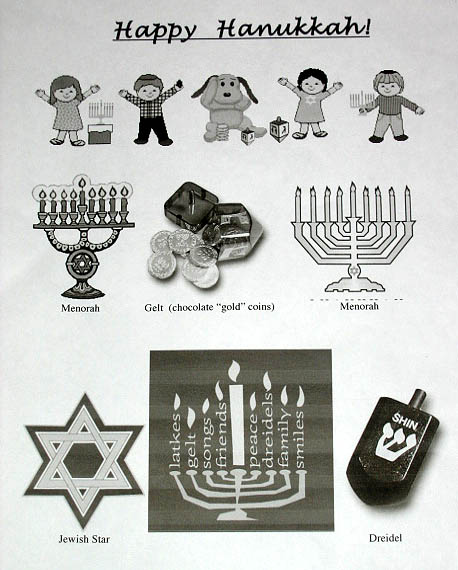 “Happy Chanukah!” I wrote on the board, emphasizing the guttural “ch.” Giggling resumed. “Hadaka?” one snickered. My religion’s holiday unfortunately sounds like the Japanese word for “naked.” I handed out a printout with images of menorahs, gelt and dreidels.
“Chocolate money [gelt] is delicious!” I cried, rubbing my tummy, hoping to jumpstart the class. Okay, Plan B: break out the games. “Do you know dreidel?” Someone echoed “jello,” another “judo.” For the 7th graders, I simplified the lesson into a Christmas dreidel game, dispensing with the whole Jewish thing altogether. The capacity of 13 year-olds to absorb a foreign topic in a foreign language is quite limited.
I divided each class into five groups, and distributed a dreidel to each. Familiar with Japanese koma counterparts, they only needed about 30 seconds of practice. Advanced dreidelers spun them upside down or on their foreheads.
I quickly switched 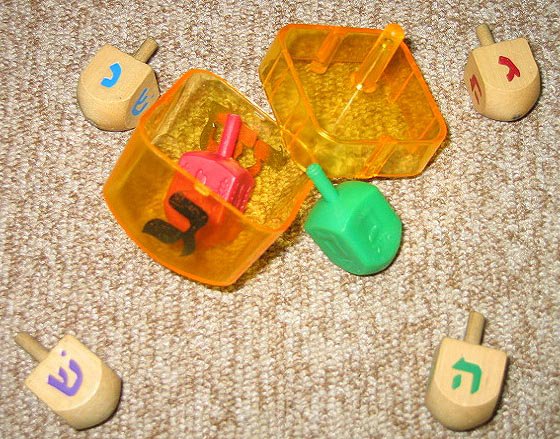 to the competition phase where one member of each group spun his or her dreidel on the floor. The last one standing earned a pencil. Everyone gathered around to watch; students instantly took a liking to the Jewish koma game.
The release from textbooks, excitement of competition and promise of prizes turned class into a festive atmosphere. After the games, we merrily sang the dreidel song until time expired. Hook, line and sinker.
Monday, October 17, 2005
D is for Delinquency
Monday morning. I pop three Advil. Starting the school week is as tough for teachers as it is for students. And when my schedule reads “Kanokita,” I down another three by lunchtime. At cooperative schools, the week’s first lesson is spent trying to revive zonked out students, who even on a lively day barely register a pulse.
At Tokyo’s worst junior high school, however, the challenge is greater. The unrestrained freedom of the weekend hasn’t worn off. Screams befitting a haunted house echo down the hallways. Metallic clanging comes from an unknown source. Mondays are like managing a prison riot.
A pack of 8th grade girls roams the hallways like dingoes in the Outback. The din outside drowned out responses of students’ weekend activities. The girls pressed their faces against the window of the sliding classroom door. When that didn’t garner enough attention, they took turns crashing into the doors, hoping to incite commotion. When that failed, Seiko flung open the door, paced around the back of the room, and stripped off her gym shorts from underneath her uniform dress. I was in for a long week. How bad is the mischief? Well, at first I mistook two late-20 year-olds as extra gym teachers because of their affinity for warm-up work clothes. It turns out that these Adidas-clad “cowboys,” as I call them, function solely to patrol the halls and round up delinquents who have lost their way to class.
The cowboys can’t catch ’em all. Discipline here is a revolving door. Teachers turn a blind eye. That was all I could do from a second floor window when I spotted two students fleeing the coop. One must have sensed my gaze because as he swung his leg over the top of the gate, he glanced up. Our eyes connected. A guilty grin crossed his face. I outstretched a hand in powerless protest. He completed the gymnastic descent, and took off down the road to catch up with his friend.
Desktops are a good barometer of a school’s discipline level. At Kanokita, they are covered with permanent black ink. Japlish graffiti artists sometimes outnumber English note takers. If students spent as much time completing handouts as on desk drawing, their proficiency might be marginally passable.
At Kanokita, the 7th graders are good, the 8th graders are bad, and the 8th grade girls are ugly. Behavior-wise, that is. Out of approximately 1,100 students at four schools, the two biggest delinquents are girls. Seiko’s brazen disregard for school rules intimidates even teachers.
Maki follows Seiko’s bad example with obedient disobedience. She is shorter but prettier than the ringleader, who at times attracts a few other otemba (naughty girls) to join her rebellion, which spurs the cowboys into action. If I were a scout, I’d offer Maki a modeling contract as soon as her grades improve. Even Taro, one of the cowboys, gives me the nod and grin when Maki passes.
While Maki is toothless without Seiko, unfortunately both are in the same English section. I was relieved but not surprised to see neither of them when I walked into class. I hoped they were terrorizing another floor or smoking off-property. Ten minutes later the sliding door rattled open, and in barged the twin terrors, carrying on a conversation that had nothing to do with the target English.
Maki plopped her knapsack on her desk, and used it as a pillow. Seiko proclaimed the window ledge as her throne, and peered out of rain-streaked windows. Wind pounded on the glass. Seiko answered nature’s call. Woooosh! English worksheets took flight, and mechanical pencils rolled off desks.
Seiko abandoned the ledge and walked around the classroom to inspect her territory – marked desktops. The wind fanned Mr. Hirogashi’s ire. Seiko remained cool, calm, and defiant. The Japanese English teacher barked. Seiko snickered. The exchange escalated. I didn’t need a translation of the unfolding brinkmanship. “Get out! GET OUT!” Seiko for once obeyed, probably wondering what took so long for the invitation. Maki grabbed her bag and followed.
Later that day, I went to the principal’s office. There, the girls would make amends, but Mr. Hirogashi remained skeptical: “They will pretend to apologize, and we will pretend to forgive them.” The twin terrors sat beside Mr. Kyobashi, the white-haired principal turned peacekeeper. I spoke first, striking a conciliatory tone: “I hope next time you can stay for the whole lesson and learn some English.” Maki smiled at the translation, but when Mr. Hirogashi spoke, Seiko looked away. She mumbled an apology to the wall.
Days later, the school counselor invited me to her office. “It’s nice to meet you,” I said. “You sure must be busy.” She wanted to chat about schools in New York that she had observed on a training program. “Do you know the South Bronx?” I answered with my eyes, and then laughed, “So you’ve seen worse.” She had visited a second chance school for juvenile delinquents that made Seiko seem like a teacher’s pet.
Tokyo is no SoBro, but the counselor picked out a similarity in that students “were not proud” of their schools. Without discipline there is no respect. And without respect there is no chance of learning. And in Tokyo there is no second chance.
Friday, July 08, 2005
Khaos at Kanokita
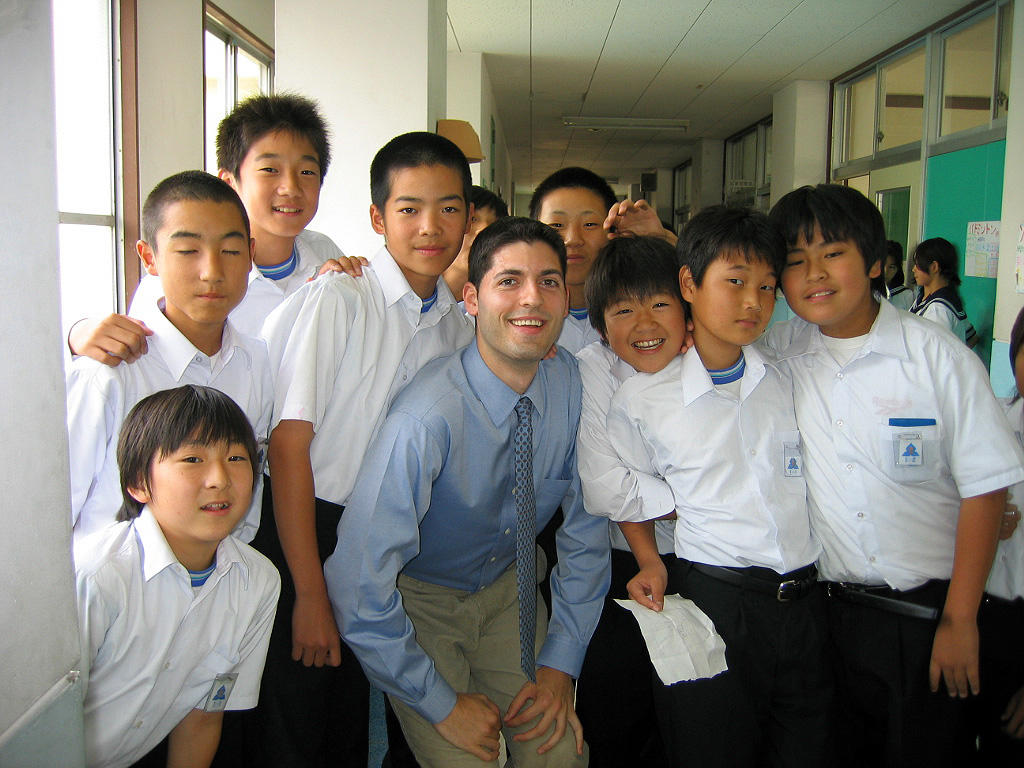
The morning assembly ended, and lessons began. Would students live up to their infamy? (See previous post). On the third floor landing, I caught my first glimpse into a classroom through its sliding plastic doors. An airborne English textbook crash-landed on the back of a student’s head. This wasn’t going to be easy. Send in the heavy artillery. Send in the 6’2” American English teacher.
Self-introduction was planned for each class. On the blackboard I scrawled my name, birthday, nationality, and caricatures of my family. Students then asked 24 questions scripted on a printout. Based on my answers, they must have wondered if a bona fide American was in their presence. “Do you like watching tv?” No. “Do you drink coffee?” No. “Do you call to your family?” No. “Do you have any pets?” No. “Not even in America?” No.
And given rumors of their reckless behavior, I wondered if these were truly Japanese students, or just American teens in disguise. Hints of ingrained disobedience included untucked school uniforms, crumpled collars, rolled up sleeves, low-hanging slacks, desktop graffiti, misaligned desk rows, and not bowing to teachers.
A madhouse describes what I walked into for my first 8th grade class. A boy sporting typical Japanese-style bed-head and a pointy chin dotted with a distinguishing birthmark unleashed havoc with pink and red highlighters. First, he desecrated another student’s desk before jabbing the boy’s white uniform. Hoping to avoid my Brooks Brothers suit from becoming a casualty, I tensed up behind the teacher’s desk out of range, wondering how to transition to “My name is Jeffrey….” The other student returned fire, and both ended upon rolling on the floor. “Son of a bitch!” the bully cried as his victim exacted revenge. Ms. Hattori passively looked on: “The students are very badly disciplined. Don’t mind that.”
The melee ended, but the bully then perched himself on another boy’s desk before returning to his seat to cut up the handout with scripted questions, the snippets of which he dumped onto the classmate in front of him. Forty minutes later, the floor looked as if it had flurried in Tokyo in July. Meanwhile, in the rear, a group of girls pushed their desks together to while away the time writing letters in a rainbow of colors, reducing my introduction to background noise.
Seventh graders greeted me with more students on the floor. Half a dozen boys were sprawled on top of one another as if practicing a rugby maneuver. The face at the bottom was turning blue; eyes bulged from their sockets. The mass of flesh untangled itself, and the boys played JanKenPo (rocks, paper, scissors) to determine the order of the next pile-on. 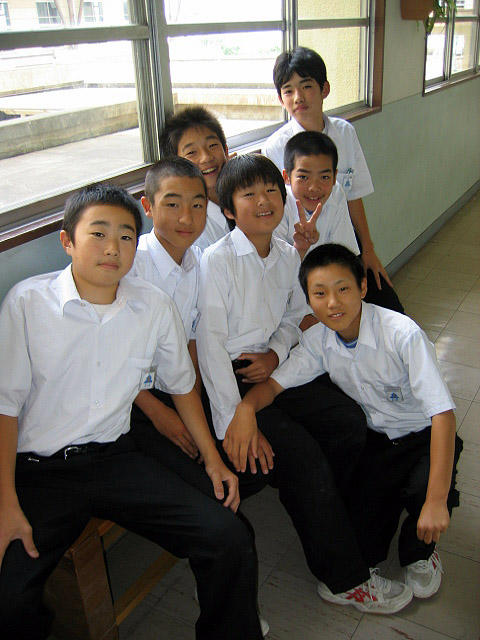 For lunch, I was permitted to dine with the most mannered and inquisitive age group (photo, right). Seventh graders nibbled silently while staring at my mastery of chopsticks, perhaps waiting for me to do something foreign like ingest the salty soup of the day through my ear canal.
Mischief resumed in the afternoon. An intimidating ninth grader approached me in the hallway. “Me too, me too,” he said out of the blue. “Nice to meet you. Yoroshiku,” I replied, to which he responded by dropping his pants and saying something in Japanese about his tighty-whities. Another student approached with a fruit carefully drawn on a folded piece of paper. “Strawberry,” I said with an encouraging smile, waiting for him repeat the new word. Instead, the fold opened, and the strawberry became a hairy penis. Welcome back to junior high.
I cringed walking into my last class of the day. Me too pants-dropper kid was at the board, which now read “I LIKE SEX.” He took a seat next to his friend in the front row, where together they recited an explicit line from a movie or rap lyrics. I had never heard any student curse until the earful I got today.
Hoping to change the topic, I showed them my picture album. “Bust size?” one asked, pointing to a female in a cocktail dress. “Big rack!” Me too concurred. I made it through my introduction, and had students introduce their names and favorite hobby. One agitated girl refused to answer, and soon after stormed out of the classroom, only to return a few minutes later to retrieve her bag and leave for good. The ultimate insolence.
At the end of day one, I had exhausted my repertoire of Teacher’s Emergency Japanese Phrases, including yamete stop!; shinai de kudasai please don’t do that!; urasai shut up! [lit.: loud]; and nani yatten da yo? what the hell are you doing? It’s a start, but next rotation I’m going armed with stronger language to enforce order. Anyone know the translation for, “Do that one more time, and I’ll shove my foot so far up your ass, I’ll kick your teeth to Yokohama?”
Wednesday, July 06, 2005
Bad to the Bone
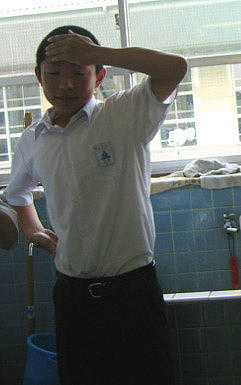 History haunts Kanokita's two-tone stairwells. The sickly pale green is scuffed black while the white above has long since yellowed. Descending the stairs on our way to the Monday morning assembly, Mr. Mochizuki and I chatted candidly about the school’s past.
“Maybe you have heard there are the most prolglrams at this school?” “Oh, that’s great," I said. "What kinds of programs do you have after school?” “No, no. Last year there were some accidents reported at this school. It was in the papers all over Japan.” I feigned innocence to milk juicy details.
In it’s 27 years, “Kanokita” and “success” have never appeared in the same sentence. Here, scholastic mediocrity is something to shoot for. This school consistently ranks among the worst in academic achievement in a society where middle school grades determine future salary through admission to top universities. There’s no celebration for second best, much less consolation prizes for dead last.
Although discipline and respect for authority are golden rules in Japanese society, exceptions exist. Like the crazily clad girls trolling Shibuya and Harajuku. And like the 8th and 9th grade boys at Kanokita. Mr. Mochizuki said these menaces walk out of class, eat in the hallways, and leave school property.
The school hit rock bottom in 2004 when police arrested15 students for violence. Teachers were not immune from assault, having been pelted with cans and bottles. [Apparently eating with the staff was for my own safety, lest I dine on knuckle sandwiches with students.] Miscreants wound up in a juvenile detention center. Publicity circulated island-wide. The school’s reputation sank into the gutter.
Student mutiny spooked off staff. After 2003, 12 of the school’s 24 teachers quit. Another 12 quit in the wake of 2004’s uprising, including all three English teachers, who simply stopped coming to work. The principal was given a permanent recess. With no outside applicants enticed to take the reigns of one of Tokyo’s most feared schools, the vice principal was promoted. Five years isn’t considered a long teaching tenure, but that’s the length of Kanokita's longest serving sensei. Teachers were down. Students were out – of control. The school was on the ropes.
Fast-forward: Kanokita is poised for a rebound in ’05. In 2004, shouts of “go back to where you came from” greeted new staff during their introductions. Teachers who scolded students had their collars grabbed in return. However, progress at this year’s boisterous but non-violent ceremony moved a board of ed. observer to tears.
In a gym retaining its late 70s appearance and creaking floorboards, students clamored throughout the assembly. Awards speeches were inaudible against the din without microphones. Then it was my turn. The color of my skin was ample amplification. Taking the stage, I sensed 400 pairs of eyes tracking me. Talking died down to murmurs, but that wasn’t good enough. “GOOD MORNING!” I bellowed. Heads snapped to center. Hush. “My name is Jeffrey. I am from America. I am from New York. I have been in Japan for three months. I live in Koto ward. I look forward to teaching you [sweeping gesture] English.” Mr. Mochizuki translated. The students clapped. I bowed. R-e-s-p-e-c-t.
At least for 30 seconds. Would it last the rest of the day? Find out what I was up against….to be continued….
Friday, July 01, 2005
The Losing Team
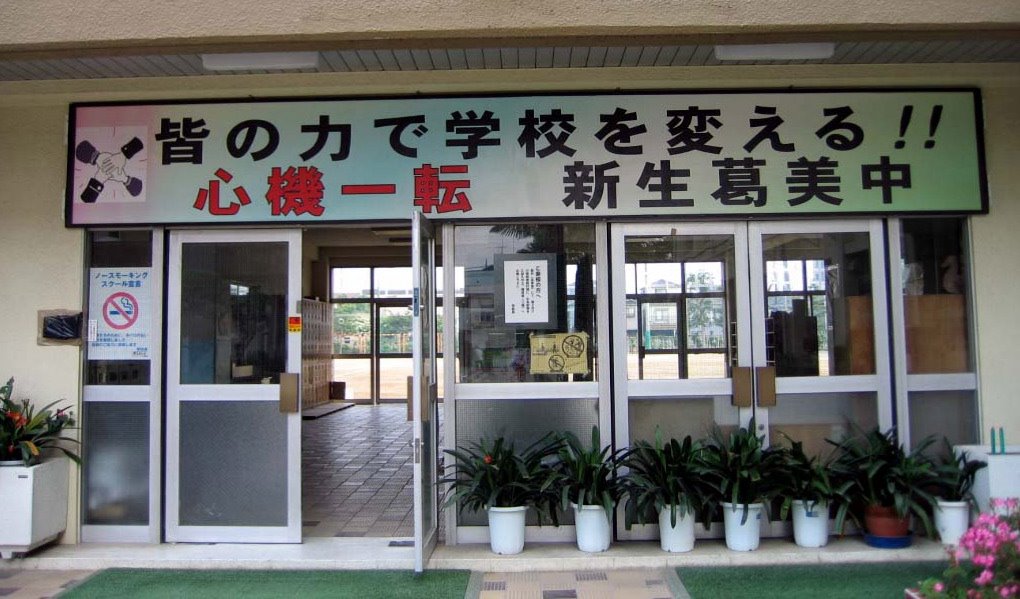 What’s it like to be on a losing team? Just ask the
 Boston Red Sox Chicago Cubs. Or the staff at Kanokita Junior High. There are two dozen junior high schools in one of Tokyo’s quiet southeastern wards. I rotate among four. Teachers at two schools weighed in about my upcoming debut at the third. “Maybe, they are the worst,” Mr. Nakamura at Nubata School advised, wrinkling his nose. “I sink they are the worst school in all of the ward,” another teacher concurred.
“I have heard some bad things about that school,” Ms. Kimura at Douyoto commented. “Last year they got some press from students fighting. Nobody wanted to send their kids there.” Okay, clearly Kanokita wasn’t the jewel in this ward's educational crown. So, what do losers want? A sure winner. Send in the American assistant English teacher. He could turn this sinking ship around. That’s exactly what Mr. Mochizuki did. I was surprised to hear from the head English teacher in advance of my first day; no other school had called me up requesting to schedule a lesson-planning meeting.
I begrudgingly obliged. I don’t get paid enough to make goodwill visits. I paced outside of the principal’s office. The frosted glass door opened, and half a dozen ninth graders filed out. Their narrow eyes, spiky hair, and rolled up sleeves announced middle school menace. Were these the kids from the newspaper? I couldn’t imagine engaging them with funny faces and American flag pencils I hand out to reward student effort.
“The principal will now make time available to see you,” Mr. Mochizuki said, ushering me into the office. Two youthful, smartly dressed teachers joined me on the couch. They, too, were part of Kanokita's ESL team. Although Mr. Mochizuki was about 50, it was his first year at Kanokita. In fact, it was everyone’s first year here. I pondered the fate of last year’s batch of English teachers. Did they walk off the job, escaping with all limbs intact? Or might I happen upon blood-soaked clothes in a janitorial closet, or find charred femurs on the soccer field? I had been warned.
In the safety of the principal’s office, everyone wanted to know how I taught lessons at the other schools of better repute. “Well, actually I am the assistant teacher. I follow the Japanese English teacher’s lesson plan.” “Ahh, I see. So you don’t have some lesson plan of your own?” “Well, sometimes I have ideas for games.” “Ahh, do you play games at the other schools?” “Yes,” although mostly I’m a human tape recorder, I wanted to add. The teachers panned for nuggets of wisdom while the Japanese-speaking principal made himself useful at the coffee machine. Quick! How do you say, "I don’t drink coffee" in Japanese?
When I mentioned eating school lunch in the classroom, Mr. Mochizuki blanched. Ms. Hattori and Mr. Hirogashi looked at each other as if I had suggested eating one of the children – an idea equally preposterous as volunteering to eat with these troublemakers. “School permitting,” Mr. Mochizuki cleared his throat. “You will eat lunch with teachers.”
Throughout the meeting I sensed that the new staff genuinely hoped to patch the school’s battered reputation. My presence would play a key role in sparking student interest in English. Nevertheless, this was a pitched battle. Unlike Jaime Escalante in “Stand and Deliver,” try as Mr. Mochizuki might, mischievous bad apples would spoil efforts at fruitful instruction.
Will Southeastern Tokyo mimic East Los Angeles? Find out next week, only at Tokyo Tanenhaus.

